



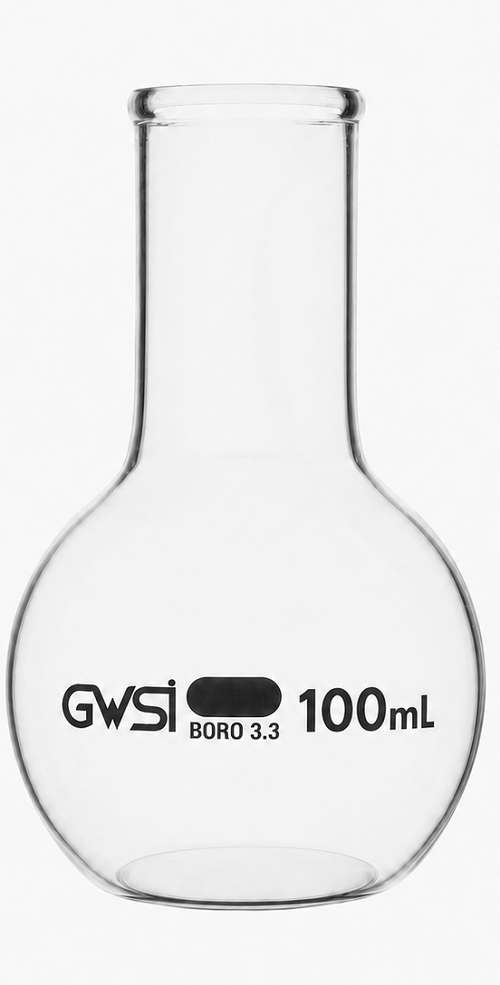
- 100 ml borosilicate boiling flask
- Flat bottom
- Wide neck
- Beaded rim for increased durability
- Made from high quality 3.3 borosilicate glass
- Low temperature gradient – can withstand high temperatures and thermal shocks*
OVERVIEW:
The GWSI Boiling Flask is a 100 ml flat-bottom vessel with a wide neck — a small flask that stays planted, not tipped, on the bench. At this size, round flasks topple the moment you let go; the flat base gives this one real footing, and the broad mouth lets you load milligram-scale charges and rinse the body clean in seconds. Premium borosilicate 3.3 glass delivers high thermal shock resistance, strong hydrolytic resistance, and total chemical inertness through hot plates and micro stirrers. Fully autoclavable lab glass, held to GWSI’s Class A and Class B volumetric glassware standard, with interchangeable ground joint options for sealed micro rigs.
HISTORY:
Small flasks have a physics problem: they’re light, so a full 100 ml flask on a round bottom rolls and tips at the slightest nudge — spilling expensive small-batch samples. The flat-bottom 100 ml solved it by giving the little flask a base wide enough to stand its ground. Add a wide neck and you have the ideal micro workhorse: stable enough to leave standing while you weigh, load, and label, and open enough to clean without a single blind corner.
APPLICATIONS:
– Pharmaceutical labs — small, heated reactions and solubility tests on hot plates.
– Biotech labs — micro buffer and reagent prep that can’t afford a spill.
– Industrial laboratories — bench QC of small, high-value samples.
– Schools, colleges & universities— beginner-friendly student experiments with fewer tip-overs.
– Research labs & educational institutes — gram-scale boiling, mixing, and crystallization.
MANUFACTURING PROCESS:
GWSI melts high-purity borosilicate 3.3 tubing, forms the flat-bottom body and wide neck by master hand-blowing or automated molding, fire-polishes the rim, then anneals every flask to relieve all thermal stress.
TESTING PROCESS :
Each flask is hand-inspected first, then run through a polariscope polarization stress test for zero residual stress, its neck, body, and base verified against ISO/DIN tolerances on manual or automatic testing machines, plus NABL gravimetric calibration on volumetric items.
PRINTING PROCESS :
Markings are applied by precision screening with glass enamels and baked in high-temperature kilns to permanently fuse the scale into the glass matrix, so it never fades.
PACKAGING PROCESS :
Finished flasks pass cosmetic sorting to filter out blemishes, then ship in heavy-duty double-wall boxes with shock-absorbing bubble wrap for safe export.
MAINTENANCE & SAFETY :
– Wash with warm detergent and a soft brush; the wide neck reaches the full 100 ml body.
– Autoclave at 121 °C and cool slowly — never set a hot flask on a cold, wet bench.
– Keep the flat base clean and dry so it stands steady and heats evenly.
– Store upright with the wide opening covered to keep dust out between runs.